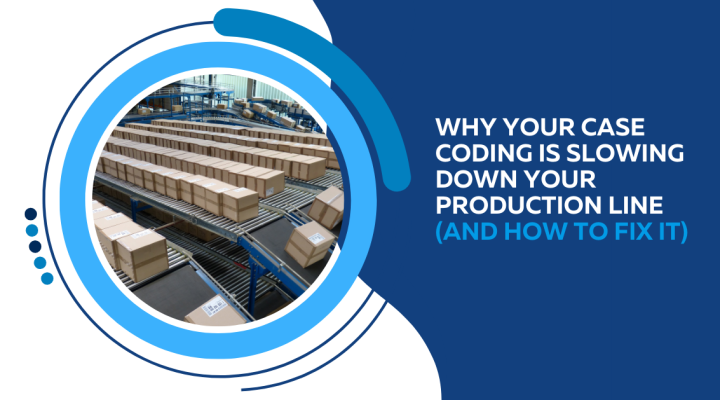
In most food factories, the focus is usually on the big machines - fillers, sealers, packers, palletisers. They get the attention because if they stop, the whole line stops.
But there’s another piece of equipment that quietly causes more disruption than many people realise.
The case coding system for food manufacturing.
When case coding works well, nobody notices it.
When it doesn’t, production slows, operators get frustrated, and suddenly the end of the line becomes the bottleneck.
After working with food and beverage manufacturers for years, we’ve seen the same problems appear again and again.
The good news? Most of them are fixable.
A modern food production line can run at incredible speeds. Yet a poorly set up case coding system can quietly chip away at that efficiency.
Here’s how it typically happens:
Each delay might only be seconds. But over a full shift, those seconds add up to significant lost productivity.
For high-volume manufacturers, inefficient production line coding can cost far more than the printer itself.
Micro-stoppages are one of the biggest hidden drains on efficiency.
Often they’re caused by:
Operators restart the line quickly, so it doesn’t always get reported - but production output suffers.
If codes are faint, smudged, or inconsistent, operators often slow the line down to compensate.
This is common with outdated industrial inkjet case coding equipment or systems not designed for corrugated packaging.
In the food industry, poor codes can also create compliance risks with retailers and traceability systems.
A reliable case coding system for food manufacturing should run with minimal input from operators.
If your team constantly needs to:
then the system is likely costing you more time than you realise.
Incorrect dates, batch codes or product information can cause serious headaches.
Best case scenario: rework.
Worst case: rejected shipments or traceability concerns.
Modern food packaging coding systems should reduce human error, not rely on it.
Many factories invest heavily in faster packing and palletising equipment but overlook the coding stage.
When the end-of-line coding can’t keep up, production is forced to slow to its speed.
That’s when frustration really begins.
Food manufacturers often inherit coding systems that were installed years ago when:
As businesses grow, those systems start showing their limits.
Common issues include:
What once worked perfectly can gradually become a drag on efficiency.
The solution usually isn’t just “buy a new printer”.
Improving case coding efficiency starts with understanding how the coding system fits into the entire production line.
Here are some practical improvements we often recommend.
Different packaging materials require different coding technologies.
Corrugated cases, shrink wrap, trays and pallet labels all behave differently.
Choosing the right case coding system for food manufacturing can dramatically improve reliability and print quality.
Coding mistakes often come from manual input.
Linking printers with production data or packaging systems can:
This is becoming increasingly important as food manufacturers move towards smarter factories.
Printer placement is often overlooked.
Poor positioning can cause:
A small adjustment can make a surprising difference to production line efficiency.
Many coding issues are predictable.
Regular servicing, correct consumables and proper setup prevent most downtime before it happens.
In busy food factories, this approach saves far more time than constant troubleshooting.
Sometimes the printer isn’t the real issue.
Case handling, conveyors, sensors or line speeds may be the root cause.
Looking at the complete end-of-line coding and labelling system usually reveals quick wins.
Case coding used to be treated as a simple add-on to packaging lines.
Today it plays a much bigger role.
Retail compliance, traceability, automation and data integration mean coding systems now directly affect operational efficiency.
A well-designed case coding system for food manufacturing should:
When it does, it disappears into the background - exactly where it should be.
If your production line occasionally feels slower than it should be, it’s worth looking at the end of the line rather than the beginning.
More often than not, the issue isn’t the big machinery.
It’s the small but essential process of getting the right code on the right case at the right time.
And when that works properly, the whole factory runs better. Contact us today and we will happily discuss your case coding requirements.

A complete solution for all industrial coding and marking equipment.
Industrial Printer Services Copyright 2026 | Created by GEL Studios