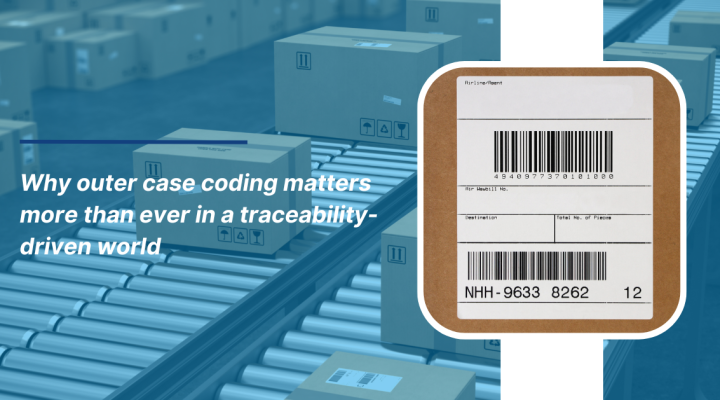
Traceability has become a non-negotiable part of modern manufacturing, and no longer a “nice to have”. It’s a commercial, regulatory, and operational necessity. While most manufacturers place a strong focus on primary pack coding, outer case coding is often treated as an afterthought - until something goes wrong.
The reality is that outer case coding plays a vital role in connecting production to the supply chain. From factory floor to warehouse, distribution centre, and retail outlet, the information printed on an outer case is what keeps products moving, compliant, and traceable.
Outer case coding refers to the printing or labelling of variable data onto secondary or tertiary packaging such as corrugated cases, cartons, or shrink-wrapped trays. These codes are designed to identify and track grouped products as they move through the supply chain.
Typical outer case codes include:
Unlike primary pack coding, which is consumer-facing, outer case coding is primarily about logistics, compliance, and operational efficiency. It is the key link between individual units and pallets, shipments, and delivery notes.
When a product leaves the production line, it rarely travels alone. It moves in cases, pallets, and loads - and that’s where outer case coding becomes essential.
Accurate, legible case coding allows manufacturers to:
In a recall situation, the difference between identifying a handful of affected cases and withdrawing an entire day’s production can come down to how robust your outer case coding system is.
Food safety regulations and retailer standards continue to evolve, and many now place greater emphasis on case-level traceability rather than just unit-level coding.
Retailers and logistics partners increasingly require:
Poor outer case coding can lead to rejected deliveries, manual relabelling, chargebacks, or delayed shipments - all of which impact margins and customer relationships.
While compliance is often the initial driver, effective outer case coding delivers tangible operational benefits.
These include:
For high-mix, high-volume environments, reliable case coding can significantly reduce downtime and inefficiency caused by misidentified or unreadable cases.
Despite its importance, outer case coding can be challenging in real-world production environments.
Common issues include:
Choosing the wrong coding technology - or relying on manual processes - often makes these problems worse rather than better.
There is no one-size-fits-all solution when it comes to outer case coding. The right technology depends on production speed, data complexity, and integration requirements.
Common solutions include:
Key considerations when selecting an outer case coding system include:
As manufacturers push towards greater automation and digital traceability, outer case coding is becoming more connected and data-driven.
Modern systems now integrate directly with production and logistics software, reducing manual data entry and minimising the risk of coding errors. Vision systems are increasingly used to verify case codes in real time, ensuring every case leaving the line is compliant and readable.
Looking ahead, outer case coding will continue to play a central role in supporting track-and-trace initiatives, retailer compliance, and supply chain transparency.
Outer case coding is no longer just about marking a box. It’s about protecting your brand, meeting regulatory obligations, and keeping products moving efficiently through the supply chain.
Manufacturers that treat outer case coding as a strategic part of their coding and labelling operation - rather than an afterthought - are better positioned to respond to audits, recalls, and changing market demands.
In a traceability-driven world, getting outer case coding right has never mattered more.
Contact us today for further guidance and support on your outer case coding and traceability requirements.

A complete solution for all industrial coding and marking equipment.
Industrial Printer Services Copyright 2026 | Created by GEL Studios