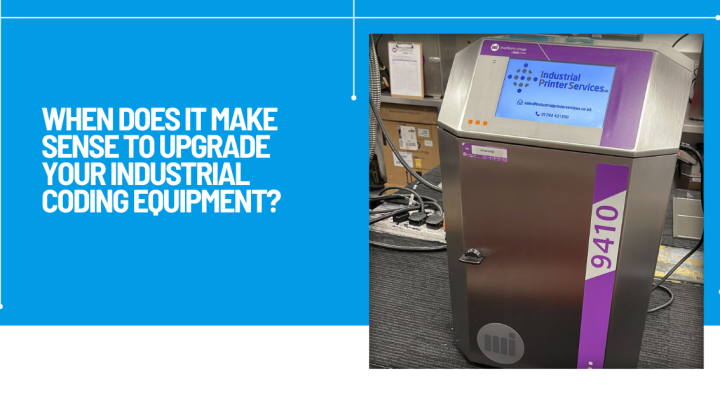
Industrial coding equipment is often something businesses continue using for as long as possible. If the printer is still producing a code, it can be tempting to assume there is no reason to change it.
But there comes a point when keeping older equipment running can become more expensive, more disruptive and more frustrating than upgrading.
The challenge is knowing where that point is.
At Industrial Printer Services, we regularly speak to production and engineering teams that are not necessarily looking to replace their equipment immediately. Often, they simply want to understand whether the problems they are experiencing are normal, whether they can be resolved or whether their existing printer is no longer the best solution for their production requirements.
The answer is rarely as simple as saying, “Your printer is old, so replace it.”
A well-maintained industrial printer can provide years of reliable service. However, changes in production volumes, packaging, coding requirements and ongoing running costs can all mean that equipment which was once perfectly suitable is no longer the right fit.
Here are some of the clearest signs that it may be time to consider upgrading your industrial coding equipment.
One of the most common reasons for upgrading is that the production line itself has changed.
Perhaps you are producing more products than you were a few years ago. Maybe line speeds have increased, new packaging formats have been introduced or the business is supplying a wider range of customers.
Your coding equipment needs to keep up with those changes.
A printer that worked perfectly well on one product, substrate or line speed may struggle when production becomes more demanding. This can result in poor code quality, missed codes, more frequent adjustments or increased operator intervention.
For food manufacturers in particular, packaging formats can change regularly. You may move between flexible films, plastic containers, glass bottles, corrugated cases or other packaging materials, each of which can present different coding challenges.
Before investing in new equipment, it is worth asking:
If the answer to several of these questions is yes, your existing system may simply be struggling to meet the demands now being placed on it.
Every production team expects occasional maintenance. Industrial equipment works hard, and servicing is an important part of keeping machinery reliable.
The concern is when downtime starts becoming routine.
If engineers are regularly being called to the same printer, or if operators are constantly stopping the line to deal with coding problems, it is worth looking at the bigger picture.
The cost is not just the cost of the repair.
A printer issue can affect production schedules, operator time, product availability and, in some cases, lead to rejected or reworked products. A relatively small coding problem can quickly become an expensive interruption when an entire production line is waiting.
Repeated faults can also make planning difficult. Production teams may begin working around a piece of equipment because they no longer have complete confidence in it.
That is usually a good indication that the situation needs to be reviewed.
In some cases, the right answer may be a repair or a change to the way the equipment is maintained. In others, the cost of continuing to repair older equipment may no longer make commercial sense.
The purchase price of an industrial printer is only one part of the overall cost of ownership.
Ink and consumable usage, servicing, spare parts, maintenance and downtime all need to be considered.
This is particularly important when a printer starts using more consumables than expected or when faults begin to occur more frequently.
For example, a business may continue repairing an older printer because each individual repair seems cheaper than replacing the machine. But over time, those costs can add up.
When you combine repeated call-outs, replacement parts, lost production time and consumable costs, keeping an older machine running may not always be the most cost-effective option.
A useful exercise is to look beyond the next repair bill and consider what the equipment has actually cost the business over the previous 12 months.
That often provides a much clearer picture.
For many manufacturers, the quality of the code is critical.
Whether you are printing batch numbers, best-before dates, barcodes or other variable information, the code needs to be clear, consistent and suitable for the packaging and application.
If codes are becoming faint, unclear or inconsistent, there may be several possible causes. The issue could relate to the printer settings, the ink being used, the condition of the equipment, the substrate or changes to the production environment.
It does not automatically mean you need a new printer.
However, if the same problems continue despite troubleshooting and maintenance, it may indicate that the current technology is no longer ideally suited to the application.
This is especially relevant where businesses have introduced new packaging materials without reviewing whether their existing coding equipment remains appropriate.
The right printer and consumable combination for one application may not be the right solution for another.
There is nothing wrong with older equipment if it remains reliable and can be properly supported.
The difficulty comes when spare parts become harder to source, specialist knowledge is limited or a breakdown could leave you waiting longer than the production schedule allows.
This can create unnecessary risk for a manufacturing business.
A good question to ask is: What would happen if this printer failed tomorrow?
If the answer involves significant production disruption, lengthy repair times or uncertainty around replacement parts, it may be time to look at your options.
That does not necessarily mean replacing everything immediately. Some businesses choose to upgrade specific high-risk areas first or introduce newer equipment on their busiest or most critical production lines.
The important thing is to have a plan rather than waiting until equipment fails completely.
Coding requirements are not standing still.
Businesses may need to print more information, accommodate different customer requirements or prepare for changes in barcode and product identification standards.
The growing use of 2D codes and increased demand for more detailed product information are good examples of why manufacturers should regularly review their coding capabilities.
If your business is relying on manual workarounds or finding that your existing equipment cannot easily handle new coding requirements, upgrading may provide an opportunity to simplify the process.
The right equipment should support your current requirements while giving you enough flexibility to adapt as those requirements develop.
This is particularly important for food manufacturers managing multiple products, packaging formats and customer specifications.
Industrial coding equipment should support production, not become another task for operators to manage.
If operators are spending significant amounts of time cleaning, adjusting, restarting or troubleshooting the printer, there may be an underlying issue with the equipment or its suitability for the application.
Operator intervention is not always a sign that the printer needs replacing. Training, maintenance or a review of the installation may resolve the problem.
However, if the equipment consistently requires more attention than it should, it is worth investigating whether newer technology could improve reliability and reduce the day-to-day workload on the production team.
Simple things can make a real difference when you are running a busy line.
For food and beverage manufacturers, accurate coding plays an important role in traceability.
Batch information, date codes and product identification need to be applied consistently and correctly throughout the production process.
As coding and traceability requirements evolve, businesses may need equipment that offers greater flexibility or supports new coding formats.
This does not mean every manufacturer needs to replace their current equipment immediately. But it is sensible to understand what your existing systems can and cannot do.
Waiting until a customer requirement or industry change forces an urgent decision can leave businesses with less time to properly assess their options.
Planning ahead allows you to consider the best solution for your production line rather than simply buying a replacement when equipment fails.
An upgrade should not simply be a case of replacing an old printer with the latest model.
The most important question is whether the equipment is right for your application.
At IPS, this means looking at the wider production environment, including:
A continuous inkjet printer may be the right solution for one application, while a different coding or labelling technology may be better suited to another.
Taking the time to understand the application first can help avoid replacing equipment with something that creates the same challenges further down the line.
It is worth saying this clearly: not every older printer needs replacing.
Sometimes a service, repair, replacement part, training session or change in consumables can resolve the issue.
That is why the best starting point is often an honest assessment of the equipment and the application.
If your current printer can continue operating reliably and cost-effectively, there may be no reason to replace it.
But if you are experiencing regular downtime, increasing running costs, inconsistent code quality or your production requirements have moved beyond what the equipment was originally designed to handle, it is sensible to explore your options.
Deciding whether to repair, maintain or upgrade industrial coding equipment should not be based on the age of the printer alone.
The right decision depends on your production requirements, the condition of the equipment, your ongoing costs and where the business is heading.
At Industrial Printer Services, we work with manufacturers to assess coding and marking applications and identify practical solutions that suit the production environment.
Whether your existing equipment needs attention or you are considering an upgrade, starting with a proper review can help you make a more informed decision.
Need advice about your current industrial coding equipment? Contact us today to discuss your application, production requirements and the options available.

A complete solution for all industrial coding and marking equipment.
Industrial Printer Services Copyright 2026 | Created by GEL Studios