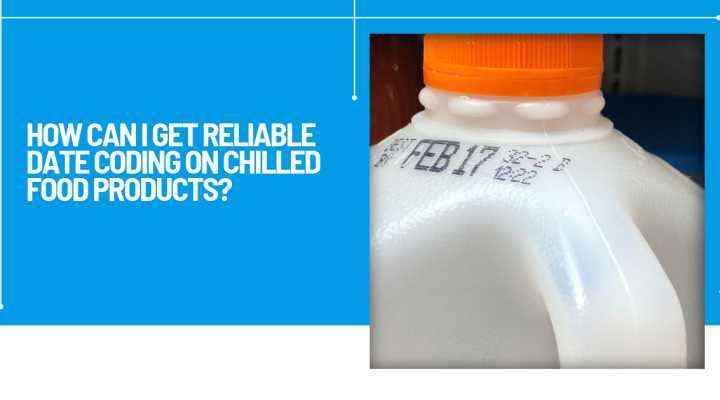
Best-before and use-by dates are among the most important pieces of information printed on food packaging. For manufacturers of dairy products and chilled foods, ensuring these codes are clear, accurate and consistently applied is an essential part of keeping production running smoothly.
But getting a reliable date code onto a chilled product isn't always straightforward.
Cold product surfaces, condensation, different packaging materials, high production speeds and regular cleaning can all affect print quality. A code that looks perfectly clear when it leaves the printer might not always remain legible through handling, packing and distribution.
So, how can food manufacturers achieve reliable date coding on chilled food products?
The answer starts with understanding the conditions on the production line, choosing the right coding technology and making sure the printer is correctly installed, maintained and set up for the application.
Date coding is more than just another stage of the packaging process. It provides essential information for retailers, distributors and consumers, helping products to be identified and managed throughout the supply chain.
For food manufacturers, poor or inconsistent date coding can create several problems:
On a busy chilled-food production line, even a relatively small coding problem can have a knock-on effect.
The aim isn't simply to print a date. It's to produce a consistent, readable code on every product, at the required position, throughout the production run.
One of the biggest challenges when coding chilled products is the environment in which printing takes place.
Products such as yoghurt, cream, milk, cheese and ready meals are often packaged in cold conditions. When products move between different temperature environments, condensation can form on the packaging surface.
This can affect how well ink adheres to the packaging, potentially resulting in:
The type of packaging and the amount of moisture present will influence how significant these problems become.
For example, printing onto a dry plastic container may present a very different challenge from coding onto a chilled, moisture-covered film or carton.
What can manufacturers do?
Start by assessing the condition of the packaging at the exact point where the code is applied.
Is the surface dry? Is condensation regularly present? Does the problem occur throughout production or only at certain times?
Where moisture is unavoidable, the coding system needs to be suitable for the application. This may involve selecting an appropriate ink, reviewing the printer position or considering whether the packaging surface needs to be better controlled before printing.
Simply increasing printer settings or changing the code position without understanding the underlying problem is unlikely to provide a reliable long-term solution.
Not all chilled-food packaging is the same, and not every coding technology will be suitable for every application.
A yoghurt pot, plastic bottle, flexible film pouch and cardboard sleeve all have different printing requirements.
The material, surface finish, available print area and production conditions should all be considered when selecting a coding system.
Common coding technologies used in food production include:
Continuous Inkjet (CIJ)
CIJ printers are widely used in food and beverage manufacturing because they can apply variable information, including dates, batch numbers and product identification codes, to products moving along a production line.
They can be suitable for a variety of packaging materials and are particularly useful where non-contact printing is required.
Thermal Transfer Overprinting (TTO)
TTO is commonly used for printing onto flexible packaging films, including the packaging used for chilled and convenience foods.
It can produce clear, high-quality codes and is particularly useful where manufacturers need to print variable information onto flexible packaging.
Piezo inkjet printing
Piezo technology can provide high-resolution printing for applications where clear, detailed codes are required. Suitability will depend on the packaging material, print position and production environment.
The important point is that the printer should be selected around the application, rather than choosing a machine first and trying to make it work with the packaging afterwards.
Chilled-food production lines can operate at high speeds, with products moving continuously through filling, sealing, labelling and packing processes.
The coding system needs to keep pace without compromising print quality.
If the printer cannot reliably apply the required information at the production line speed, manufacturers may experience missing characters, inconsistent positioning or poorly formed codes.
Printer positioning is equally important.
The printhead needs to be installed at the correct distance and angle from the product or packaging. Products must also pass the printhead consistently to ensure the code appears in the correct position.
It is worth considering:
For manufacturers running several packaging formats or changing between products throughout the day, flexibility also needs to be considered.
A coding system that works well for one product may need adjustments when the packaging format or production speed changes.
Selecting the correct printer is only part of achieving reliable date coding. The ink, ribbon or other printing consumables must also be appropriate for the packaging and production environment.
For inkjet printing, ink selection can have a significant effect on adhesion, drying time and resistance to handling.
A code that looks clear immediately after printing but smudges when touched or handled is not providing the reliability a manufacturer needs.
Similarly, TTO applications require the correct ribbon for the packaging material and printing conditions.
Manufacturers should consider:
It is also important to use compatible consumables and follow the printer manufacturer's recommendations.
Where print quality is inconsistent, reviewing the ink or ribbon being used can be a useful starting point before considering a replacement printer.
Chilled-food production environments can be demanding for industrial coding equipment.
Frequent washdowns, changes in temperature, moisture and the general conditions around food production lines can all influence printer performance.
Over time, a lack of routine maintenance can contribute to blocked printheads, inconsistent printing, consumable problems and unexpected downtime.
A straightforward maintenance routine can help reduce the likelihood of these issues.
This should include:
Maintenance requirements will vary depending on the printer technology and the production environment.
For manufacturers operating multiple shifts, it is also worth making sure operators understand the basic checks they should carry out and when an issue needs to be referred to an engineer.
One of the easiest things to overlook is checking whether the code remains readable throughout the production process.
A printer may be producing perfectly acceptable codes at the start of a shift, but performance can change as production conditions vary.
Changes in packaging, temperature, moisture levels, line speed or consumables can all affect the result.
Regular checks help manufacturers identify problems early, rather than discovering an issue when finished products are being packed or prepared for dispatch.
It is worth checking:
Where specific code quality or verification requirements apply, manufacturers should also establish suitable inspection procedures.
The important thing is to make code quality part of the production process, rather than treating it as something to check only when a problem occurs.
Even with the right printer and consumables, getting reliable date coding can take some fine-tuning.
Every production line is different. The packaging, operating conditions, available space and production speeds all influence which solution will work best.
Working with an experienced industrial coding supplier can help manufacturers assess the application before investing in new equipment.
This might involve reviewing the existing printer, testing alternative inks or ribbons, adjusting the installation or recommending a more suitable coding technology.
It is also worth considering the support available after installation.
If a printer develops a problem during a busy production shift, having access to technical support, compatible consumables and replacement parts can make a significant difference.
For manufacturers operating chilled-food production lines, reliable support is just as important as selecting the right machine in the first place.
There isn't one coding solution that will work for every chilled-food application.
The most reliable approach is to look at the complete production process, from the packaging material and product temperature through to the printer installation, consumables and ongoing maintenance.
Before choosing or changing a coding system, manufacturers should consider:
Getting these details right can help reduce coding-related downtime, minimise packaging waste and maintain consistent date coding across production.
At Industrial Printer Services (IPS), we help food and beverage manufacturers find practical industrial coding solutions for their production requirements.
We supply, install and support a range of industrial coding equipment, including Markem-Imaje continuous inkjet printers and thermal transfer overprinters.
Whether you're experiencing problems with codes on chilled packaging, struggling with ink adhesion, or looking to upgrade an existing coding system, we can help assess your application and identify a suitable solution.
We also provide ongoing servicing, technical support, compatible inks and fluids, and operator training to help keep your production lines running efficiently.
Contact us today to discuss your requirements with the team at IPS, and find out how we can help improve coding reliability on your production line.
Industrial Printer Services – helping manufacturers reduce printing costs and improve production efficiency.

A complete solution for all industrial coding and marking equipment.
Industrial Printer Services Copyright 2026 | Created by GEL Studios