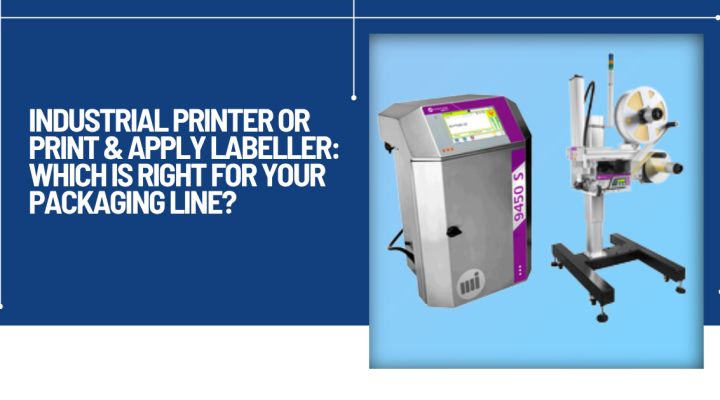
Choosing the right coding and labelling equipment for a packaging line is not always straightforward.
For some manufacturers, an industrial printer provides everything needed to apply variable information directly onto a product or package. For others, a print & apply labelling system may be the better solution, particularly where labels need to carry more information or be applied to a specific location.
So, which is right for your production line?
The answer depends on what you are producing, what information needs to be applied, the packaging materials involved and how your production line operates.
An industrial printer applies variable information directly onto a product, package or label-ready surface.
Depending on the application, industrial coding and marking equipment can be used to print information such as:
Industrial printers are commonly used in manufacturing and packaging environments where information needs to be applied quickly and consistently as products move through production.
One of the key advantages is that there is no separate label to produce and apply. The code is printed directly onto the product or packaging.
A print & apply labeller prints variable information onto a label before automatically applying that label to the product or packaging.
This can be particularly useful when the required information needs to be presented on a larger label or when the packaging material or surface is not suitable for direct printing.
A label can accommodate more information than a small direct-print code and can also provide a defined area for branding, product identification, barcodes and other information.
Print & apply systems can therefore be particularly useful in applications such as cases, cartons, pallets and other larger packaging formats.
The main difference is how the information is applied.
An industrial printer prints directly onto the product or packaging.
A print & apply labeller prints onto a separate label and then applies that label to the product or packaging.
Neither approach is automatically better.
The right choice depends on the requirements of the production process.
| Consideration | Industrial printer | Print & apply labeller |
| Application | Direct onto product or packaging | Printed label applied to product or packaging |
| Typical information | Dates, batch codes, barcodes and variable data | Variable data plus larger amounts of information |
| Label required | No | Yes |
| Space required | Generally compact print area | Larger label area available |
| Packaging surface | Needs a suitable print surface | Label provides the print surface |
| Typical applications | Bottles, cans, flexible packaging and individual products | Cases, cartons, boxes and pallets |
An industrial printer can be a good option when production requires fast, direct coding on individual products or packaging.
For example, if you need to add a batch number or date code to products travelling quickly along a production line, direct printing can provide a simple and efficient solution.
It can also be advantageous where:
You need high-speed coding.
Industrial printers are designed for production environments where products may be moving continuously through the line.
You want to avoid the additional consumable of a separate label.
Because the information is printed directly onto the packaging, there is no label stock involved.
The packaging has a suitable print surface.
The choice of printer and ink or other printing technology needs to be matched to the material and production environment.
You are primarily applying variable production information.
For straightforward batch, date and traceability information, direct coding can be an efficient approach.
A print & apply labelling system may make more sense when the application requires a larger amount of information or when the packaging does not provide an appropriate surface for direct printing.
For example, cases and cartons may need labels containing product information, barcodes, logistics information or other data.
Print & apply can also be useful when a clearly defined label area is required.
The label effectively creates its own print surface, giving manufacturers greater flexibility over how information is presented.
The most important question isn't simply:
“Which technology is better?”
It is:
“Which technology is better suited to our production process?”
There are several factors worth considering.
Start with the information itself.
A simple date or batch code may require a very different solution from a large logistics label containing multiple barcodes and variable information.
Understanding the amount and type of information is one of the first steps in choosing the right technology.
The packaging material matters.
Different materials and surfaces can present different requirements for print adhesion, durability and readability.
A coding solution that works well on one packaging material may not be appropriate for another.
Production speed is another important consideration.
The coding or labelling equipment needs to keep pace with the line without becoming a bottleneck.
It is therefore important to consider not only the printer's specifications but how the complete system will operate within the production environment.
The location of the code or label can influence the choice.
Direct printing may be ideal where a defined print area is already available. In other applications, a print & apply system may provide greater flexibility in positioning the information.
Production requirements can change over time.
New products may be introduced, packaging formats may change or customers may require additional information.
When investing in coding or labelling equipment, it is worth considering whether the solution will continue to meet your requirements as the production line develops.
Cost should also be considered, but looking only at the initial equipment price can give an incomplete picture.
The total cost of a coding or labelling solution can include consumables, maintenance, replacement components, downtime and operator involvement.
A solution that appears less expensive initially may not necessarily provide the lowest overall cost over its working life.
Likewise, a more capable system may provide better value if it reduces manual intervention, improves reliability or provides the flexibility needed for future production requirements.
The best approach is to consider total cost of ownership alongside operational suitability.
For some production lines, an industrial printer will be the obvious choice.
For others, print & apply will provide the flexibility and information capacity required.
And in some manufacturing environments, the best solution may involve using both technologies in different parts of the production process.
The important thing is to start with the application rather than the equipment.
Understand what needs to be printed, where it needs to be applied, what the production environment demands and what the business may need in the future.
From there, it becomes much easier to identify the right technology.
No. An industrial printer applies information directly onto the product or packaging, whereas a print & apply system prints information onto a separate label before applying that label to the product or packaging.
Neither is universally better. The right choice depends on the product, packaging material, information being applied, production speed, application requirements and overall production process.
Yes. Depending on the printer technology and configuration, industrial printing systems can be used to print barcodes, 2D codes and other variable information.
Print & apply can be particularly suitable when products or cases require larger labels, multiple pieces of information, logistics data or a dedicated label surface.
Start by assessing the product, packaging material, required information, print location, production speed and operating environment. A suitable system should meet the current application while also providing appropriate flexibility for future requirements.
Choosing between an industrial printer and a print & apply labeller is ultimately about finding the right fit for the application.
The technology should support the production process rather than force the production process to adapt around it.
By considering the information required, packaging format, production speed, print location, consumables and future requirements, manufacturers can make a more informed decision and avoid investing in equipment that isn't suited to the job.
If you're reviewing your current coding or labelling setup, the starting point should always be the production requirement.
Once you understand the application, the right technology becomes much clearer.
Need help with coding and labelling at your business? Contact us today.

A complete solution for all industrial coding and marking equipment.
Industrial Printer Services Copyright 2026 | Created by GEL Studios