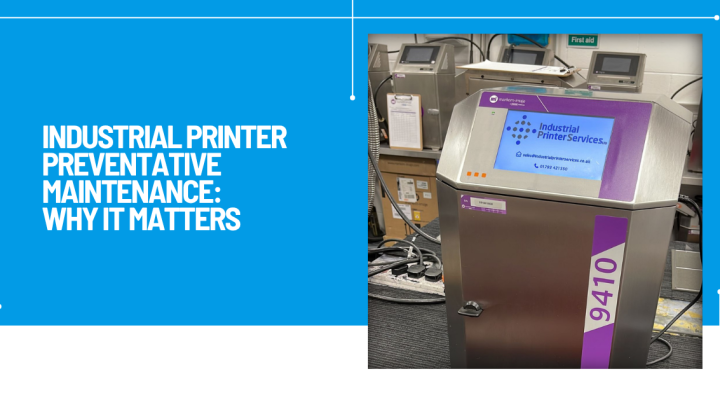
When people talk about preventative maintenance for an industrial printer, cleaning is often the first thing that comes to mind.
And yes, keeping equipment clean matters.
But preventative maintenance is about much more than wiping down a printer or clearing a printhead.
For manufacturers, it is about identifying small issues before they develop into faults that interrupt production, affect coding quality or require an unexpected engineer call-out.
In a busy production environment, that difference can have a significant financial impact.
Industrial printers work hard.
Whether you're coding bottles, cans, packaging or other products, the equipment may be operating for long periods and at high production speeds. Components naturally experience wear, and small changes in performance can develop gradually.
A printer might continue working despite an issue for days or even weeks.
Perhaps the print quality is becoming less consistent. Perhaps a component is beginning to wear. Perhaps the machine is behaving differently from normal, but production is still running.
It can be tempting to carry on.
The problem is that a developing fault doesn't necessarily remain a minor fault.
A small issue can become a more significant failure, potentially resulting in:
This is why preventative maintenance should be viewed as production protection, not simply printer housekeeping.
Effective preventative maintenance means looking at the overall condition and performance of the printer.
That can include checking components for wear, assessing print quality, identifying changes in machine behaviour and making sure potential problems are dealt with before they become disruptive.
It is also about understanding the environment in which the printer is operating.
A coding system running continuously on a fast beverage production line has different demands from equipment operating in a lower-volume environment.
Dust, moisture, temperature, production speed and the type of product being coded can all influence equipment performance.
A good maintenance approach takes those conditions into account.
Maintenance isn't only about whether the printer is running.
It is also about whether it is producing the right result consistently.
A printer can technically be operational while gradually producing less reliable or less consistent codes.
For manufacturers, that matters.
Date codes, batch information, lot numbers and other variable information need to remain clear and legible throughout production. Problems with print quality can create additional inspection, rework or waste — and in some situations can affect whether products are able to move through the supply chain as planned.
Regular attention to the equipment can help identify changes before they become a bigger production issue.
The strongest reason to take preventative maintenance seriously is not simply that it keeps equipment in good condition.
It is that planned maintenance is generally easier to manage than unplanned downtime.
Consider a relatively simple chain of events:
Small developing issue → fault becomes worse → printer stops → production is interrupted → emergency support is required → production time is lost.
The original problem might have been relatively inexpensive to address.
The resulting disruption may not be.
There can also be costs that aren't immediately visible: operators waiting for equipment, production schedules being rearranged, products being held, additional waste and engineering resources being diverted to an unexpected problem.
Preventative maintenance helps move the conversation from:
“How much will it cost to maintain the printer?”
to:
“What could it cost us if we don't?”
There isn't necessarily one maintenance routine that suits every manufacturer.
The right approach depends on factors such as production hours, operating conditions, printer usage, product type and the demands placed on the coding system.
That's particularly important in high-speed manufacturing, where even a relatively short interruption can have consequences beyond the printer itself.
Understanding the production process is therefore an important part of maintaining the equipment supporting it.
No maintenance programme can guarantee that a printer will never develop a fault.
Equipment can fail, components wear and unexpected problems happen.
The purpose of preventative maintenance is to reduce avoidable risk and give production teams a better chance of identifying developing problems before they become disruptive.
For manufacturers, that's the real value.
It's not about keeping a printer looking clean.
It's about keeping the production process reliable, predictable and moving.
And when a relatively small maintenance intervention can prevent a much larger production problem, preventative maintenance starts to look less like a routine cost and more like sensible production planning.
Need help with coding and labelling at your business? Contact us today.

A complete solution for all industrial coding and marking equipment.
Industrial Printer Services Copyright 2026 | Created by GEL Studios