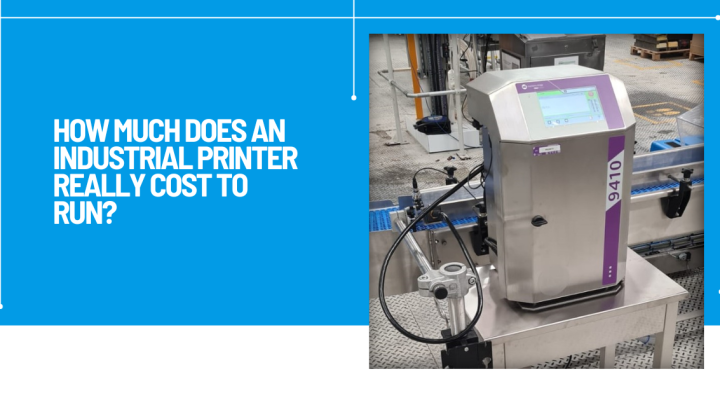
When you're looking at a new industrial printer, it's tempting to focus on the purchase price. And that's understandable. If one printer costs £5,000 and another costs £8,000, the cheaper option can appear to be the obvious choice. But that's not necessarily how the numbers work out once the printer is running on a production line.
The real cost of an industrial printer isn't simply what you pay to buy it. It's what you spend on ink, consumables, maintenance, spare parts, servicing, energy, operator time and, perhaps most importantly, downtime over the life of the machine. That is why two printers with very different purchase prices can end up costing surprisingly similar amounts, or why a machine with a higher initial price can sometimes prove the more economical option in the long run.
So, how much does an industrial printer really cost to run?
The honest answer is: it depends on how you use it.
There are several costs worth considering when you're assessing an industrial coding system.
These include:
Some of these costs are easy to see on an invoice. Others are much harder to spot. And it's often those hidden costs that make the biggest difference.
Let's say you're comparing two industrial printers. Printer A costs less to buy, while Printer B has a higher initial price. It would be easy to assume Printer A is the better deal. But what happens if Printer A uses considerably more consumables, requires more frequent attention from operators or experiences more downtime?
After three, four or five years, the difference in purchase price may look far less important.
This is why manufacturers should consider total cost of ownership (TCO) rather than simply asking:
"How much does the printer cost?"
A better question is:
"How much will this printer cost us to own and operate over its useful life?"
That change in thinking can make a significant difference when comparing equipment.
For many industrial inkjet printers, ink and associated consumables are an ongoing operating cost.
How much you use will depend on factors such as:
A production line running for a few hours a day will have very different consumable requirements from a factory operating multiple shifts, seven days a week.
That's why looking at a manufacturer's headline consumable figure isn't always enough.
You need to consider your actual production environment.
Not every printed message has the same cost.
A simple batch number containing a few characters requires considerably less ink than a large multi-line message containing detailed product information, logos or complex codes.
The same applies when your coding requirements change.
If your business moves towards more detailed traceability information, barcodes or 2D codes, the amount of data being printed can increase.
That doesn't automatically mean running costs will become excessive, but it is something worth considering when choosing a coding system.
The printer needs to be capable of handling the codes you need today - and ideally the ones you expect to need tomorrow.
Nobody wants to spend money maintaining a printer.
But planned maintenance is generally much easier to budget for than an unexpected production stoppage.
A service visit, replacement component or routine maintenance task has a visible cost.
A printer failure in the middle of a production run can be much harder to quantify.
You could be dealing with:
And there is another cost that is sometimes overlooked: the time your own team spends trying to get the printer working again.
If an operator spends an hour troubleshooting a recurring problem, that is still a business cost - even if nobody receives an invoice for it.
Every industrial printer contains components that will eventually need attention or replacement.
The exact parts will depend on the technology and model, but examples can include filters, pumps, printhead components and other wear items.
A printer that is inexpensive to purchase but expensive to maintain may not be the bargain it initially appears to be.
When comparing machines, ask what the common replacement parts are, how readily available they are and what support is available when something does go wrong.
Availability matters too.
A part sitting in a warehouse is of little use if you cannot get it when you need it.
How easy is the printer to use?
It's a question that can be overlooked when comparing specifications.
If operators need to spend significant amounts of time:
then those activities become part of the true operating cost.
This doesn't necessarily mean the printer with the most automated features is automatically the right choice.
It means you should consider how much hands-on involvement the equipment will require in your particular production environment.
A few minutes saved here and there can become many hours over a year.
This is the one we'd encourage manufacturers to think about most carefully. Imagine your coding printer stops and brings the production line to a halt.
If the line produces £X worth of product every hour, the cost of the printer failure isn't simply the engineer's call-out fee. You're also potentially losing production capacity. And the longer the issue takes to resolve, the bigger that number becomes.
This is why reliability should be considered alongside purchase price.
A printer that costs slightly more but gives you greater confidence in keeping the line running may provide better value than a cheaper machine that creates repeated interruptions.
The cheapest printer isn't necessarily the cheapest printer to run.
Industrial printers don't operate in isolation.
When you're choosing equipment, think about what happens after installation.
These aren't just support questions. They're cost questions.
A reliable support arrangement can make your costs more predictable and reduce the risk of a relatively small printer problem turning into a much larger production issue.
For manufacturers running critical production lines, that can be worth considerably more than saving a few pounds on the initial purchase.
This is where total cost of ownership becomes particularly useful.
Imagine two hypothetical machines:
Printer A
Printer B
Printer A may look cheaper when you compare the quotations.
But after several years of production, Printer B could potentially cost less overall.
That's why a good purchasing decision shouldn't be based solely on the number at the bottom of the equipment quotation.
You don't need a complicated financial model to get a useful starting point.
Look at the following over a typical year:
Annual printer cost =
Consumables + servicing + spare parts + repairs + operator time + downtime + other operating costs
Then consider the expected working life of the equipment.
It's worth looking at actual figures from your production environment rather than relying entirely on generic estimates.
For example, ask:
You may be surprised by the answer.
For some manufacturers, spreading the cost of equipment and support over a fixed period can make budgeting easier.
Instead of treating the printer, servicing and support as completely separate costs, a service and warranty package can provide a more predictable monthly or annual expenditure.
This can be particularly useful when production managers need to control capital expenditure while still ensuring the coding equipment is properly supported.
However, it's important to look carefully at what any package actually includes.
Ask about:
The cheapest package isn't necessarily the best package if important costs sit outside it.
There isn't one figure that applies to every manufacturer.
A small production line printing a simple batch code for several hours a day will have very different costs from a high-speed food or beverage line running continuously across multiple shifts.
The important point is that the purchase price is only one part of the equation.
When comparing industrial printers, look at the whole picture:
Purchase price → consumables → maintenance → support → downtime → lifespan → total cost of ownership
That's where you get a much more realistic idea of what you're actually buying.
When you're investing in industrial coding equipment, it can be tempting to focus on getting the lowest possible purchase price.
But production equipment should be judged by what it delivers over its working life.
A printer that provides reliable coding, sensible consumable usage, straightforward operation, accessible support and predictable maintenance can ultimately represent much better value than a machine that simply looks cheaper on day one.
At Industrial Printer Services, we don't believe choosing an industrial printer should come down to a price on a quotation alone.
The right solution depends on your production volumes, substrates, coding requirements, operating environment and the level of support you need.
If you're considering a new industrial printer or want to understand what your current coding equipment is really costing your business, we'd be happy to discuss the options with you - Contact us today.
Sometimes the most useful question isn't "How much does the printer cost?"
It's "How much does it cost us every time it doesn't do what we need it to?" for help and support.

A complete solution for all industrial coding and marking equipment.
Industrial Printer Services Copyright 2026 | Created by GEL Studios