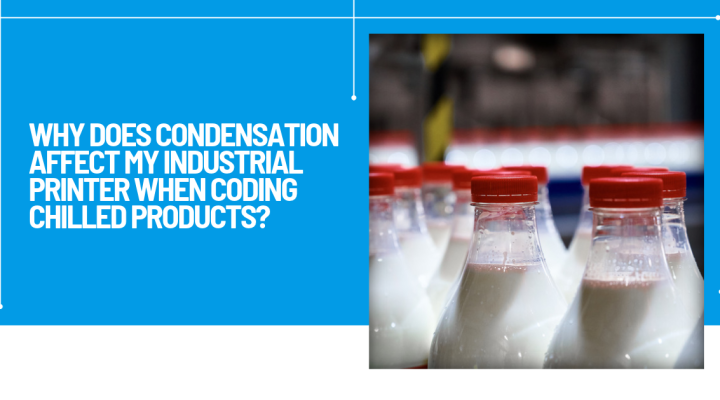
If you manufacture dairy products, chilled ready meals, fresh food or other temperature-controlled products, condensation can create an unexpected challenge on your production line.
You might have an industrial printer that normally produces clear, consistent batch codes, date codes and product information. But when production involves chilled products or packaging, print quality can suddenly become less reliable.
Codes may appear blurred, fail to adhere properly, smudge after printing or become difficult to read further down the production line.
It's easy to assume that the printer is developing a fault. However, the problem may have very little to do with the printer itself.
Condensation can affect industrial printing because moisture on the product or packaging surface can interfere with ink transfer, adhesion and the final appearance of a printed code.
For manufacturers working with chilled products, understanding why this happens and what can be done to reduce its impact is an important part of maintaining reliable product coding.
Condensation occurs when moisture in the surrounding air comes into contact with a surface that is colder than the air's dew point.
This is something that happens regularly in food and beverage manufacturing environments.
For example, products may leave refrigerated storage and move into a warmer production or packaging area. As the temperature of the surrounding air increases, moisture can collect on the colder product or packaging surface.
The result is a thin layer of water droplets that may not always be obvious to the naked eye.
This can be particularly common when coding:
The challenge is that industrial printers are expected to apply clear, accurate codes at production speed, often onto packaging that is not necessarily in ideal printing conditions.
Even a small amount of surface moisture can make a difference.
The impact of condensation depends on the printer technology being used, the type of ink or consumable, the packaging material and the amount of moisture present.
However, there are several common problems manufacturers may experience.
One of the most common issues is poor adhesion.
When ink is applied to a wet or damp surface, it may struggle to bond consistently with the packaging material.
This can result in codes that appear faint, uneven or incomplete.
In some cases, the code may initially look acceptable but become less durable when the product is handled, packed or moved through the rest of the production process.
This is particularly important where batch numbers, production dates and traceability information need to remain readable throughout the product's journey.
Moisture can also affect the appearance of a printed code.
Depending on the ink and substrate, water droplets or a film of condensation can cause ink to spread, disrupt the printed characters or contribute to smudging.
The result may be a code that is difficult to read, particularly when printing small characters, barcodes or other information where clarity is essential.
For manufacturers, this can create problems during inspection, packing and distribution, especially if codes no longer meet the required quality standards.
Condensation does not always affect every product in the same way.
One container may have very little moisture on its surface, while the next may have noticeably more.
This can lead to inconsistent coding across the production run.
Operators may notice that some codes are perfectly clear while others are faint, blurred or incomplete, despite the printer settings remaining unchanged.
This is one reason why condensation-related problems can sometimes be difficult to diagnose.
The printer may be operating correctly, but the conditions in which it is applying the code are changing.
It's also worth considering the wider packaging process.
For manufacturers using labels, thermal transfer printing or print-and-apply systems, moisture can introduce additional challenges.
For example, condensation may affect label adhesion, particularly if labels are being applied to cold or damp packaging.
In thermal transfer applications, the condition of the label surface can also influence the quality and consistency of the printed information.
The important point is that condensation can affect more than just the printing process itself. It can influence the entire coding and labelling operation.
Not necessarily.
If your industrial printer has been producing reliable codes but print quality starts deteriorating when chilled products are introduced to the line, it's worth looking beyond the printer.
Before assuming that the printhead, ink system or printer settings are responsible, consider the conditions surrounding the application of the code.
There are several factors worth investigating.
Are products coming directly from refrigerated storage or a chilled processing area?
A significant difference between product temperature and the surrounding air temperature can increase the likelihood of condensation forming.
Different packaging materials behave differently when exposed to moisture.
Plastic bottles, flexible packaging, coated cartons and metal containers may all present different coding challenges.
The surface finish and condition of the packaging can influence how effectively an ink or other marking method performs.
Where is the code being applied?
If the printer is positioned immediately after a chilling, washing or cooling process, the packaging may still be wet when it reaches the printhead.
Moving the coding point further along the production line, where practical, may allow more time for surface moisture to reduce.
Temperature, humidity and airflow can all influence condensation.
Changes between production areas, open chilled storage, frequent door openings and variations in line conditions may contribute to inconsistent results.
Not every industrial printer or ink is suitable for every packaging application.
The correct solution depends on the substrate, production environment, line speed and the conditions in which the code needs to perform.
This is why testing the complete application is so important.
There isn't one solution that works for every chilled food production line.
However, there are several practical steps manufacturers can take to improve coding reliability.
Start by looking at the position of the printer in relation to the chilling, cooling or washing processes.
If products are being coded immediately after leaving a cold environment, consider whether the application point could be moved further along the line.
Even a small change in position may provide additional time for surface moisture to reduce.
Of course, this needs to be assessed alongside production speed, available space and any traceability requirements.
Before investigating printer settings, establish whether the packaging is wet, damp or visibly covered in condensation when it reaches the coding point.
Look for patterns.
Does the problem occur more frequently during certain production runs? Is it worse on products coming directly from cold storage? Does print quality improve when the packaging surface is drier?
Understanding when the problem occurs can help identify whether moisture is contributing to the issue.
The choice of ink is important.
Different inks are formulated for different substrates and production conditions. An ink that performs well on a dry plastic bottle may not necessarily deliver the same results when applied to a cold or damp surface.
If condensation is a recurring problem, it may be worth reviewing whether the current ink is appropriate for the application.
This should involve testing on the actual packaging, under realistic production conditions, rather than relying solely on specifications or recommendations.
Although condensation may be the underlying issue, the printer itself should not be overlooked.
Incorrect settings, a poorly maintained printhead or unsuitable operating parameters can make an existing coding challenge worse.
Regular maintenance, correct printer configuration and appropriate consumables all play a part in achieving consistent results.
However, increasing ink output or changing settings without understanding the cause of the problem may simply increase running costs without resolving the underlying issue.
Before changing printers, inks or production processes, carry out controlled testing.
Compare print results on packaging with different moisture levels, where this can be done safely and without compromising product quality or production requirements.
Check the finished code for:
Testing should reflect the actual conditions the printer will encounter during normal production.
The objective is not simply to produce a code that looks acceptable immediately after printing. It needs to remain readable and meet the relevant requirements throughout the product's intended journey.
There isn't a single industrial printer that is automatically best for every chilled food application.
The right choice depends on several factors, including the packaging material, line speed, production environment, code requirements and whether the packaging surface is likely to be wet or dry when coding takes place.
Continuous Inkjet (CIJ) printers are widely used in food and beverage manufacturing for applying date codes, batch numbers and other product information to packaging.
For suitable applications, CIJ technology offers non-contact printing at production speeds, making it a practical option for many manufacturing environments.
Thermal Inkjet, thermal transfer and print-and-apply labelling systems may also be appropriate depending on the packaging and coding requirements.
However, selecting the right printer is only part of the decision.
The ink, ribbon or label must also be suitable for the application, and the complete setup needs to be tested under realistic production conditions.
At IPS, we work with manufacturers to understand their coding requirements and identify suitable industrial printing and labelling solutions.
Need help? Contact us today.

A complete solution for all industrial coding and marking equipment.
Industrial Printer Services Copyright 2026 | Created by GEL Studios