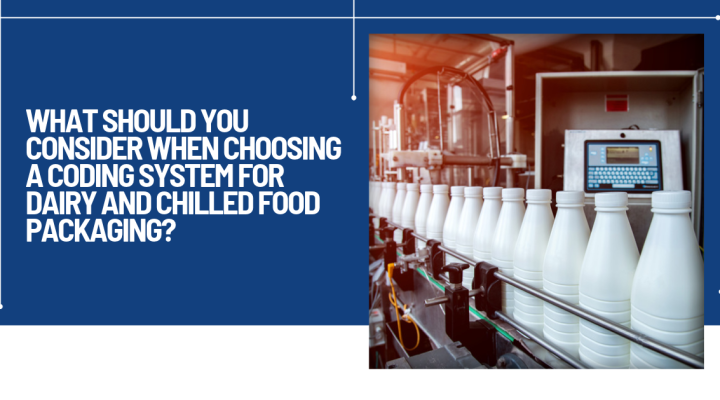
Choosing an industrial coding system for a dairy or chilled food production line isn't simply a case of finding a printer that can apply a date code.
Different products, packaging formats and production environments all bring their own challenges. A system that works perfectly for printing batch numbers onto plastic bottles may not be the best option for coding flexible film, cartons or ready-meal trays.
Then there are the practical considerations that can easily be overlooked when comparing equipment.
How fast does your production line run? Will the packaging be cold or damp when the code is applied? How much space is available for printing? What happens during cleaning? And how easy will the system be to maintain?
Getting these decisions right from the beginning can make a significant difference to coding reliability, production efficiency and the overall cost of running your equipment.
So, what should manufacturers consider when choosing a coding system for dairy and chilled food packaging?
One of the first things to establish is exactly what you're printing onto.
Dairy and chilled food manufacturers work with a wide variety of packaging materials, and each presents different coding requirements.
For example:
The important point is that not all packaging surfaces behave in the same way.
The ink or marking technology needs to be compatible with the material to achieve a clear, durable and readable code.
Before choosing equipment, establish the exact substrate, its surface characteristics and where the code needs to appear.
Dairy and chilled food manufacturing environments can be demanding.
Products may move between refrigerated storage, processing areas, filling equipment and packaging lines. Temperature changes, moisture and regular cleaning can all influence how well a coding system performs.
This is particularly relevant when coding chilled products.
As discussed in our previous blog, condensation can affect the way ink transfers and adheres to packaging.
If products are being coded immediately after chilling, the packaging may be damp when it reaches the printer.
This needs to be considered when selecting both the printer and the consumables.
Some applications may benefit from reviewing the position of the coding equipment to allow surface moisture to reduce before printing, where production requirements permit.
Cleaning is another important consideration.
Food manufacturing equipment needs to operate within the site's hygiene and cleaning procedures. Coding equipment may be exposed to regular washdowns, cleaning chemicals, moisture and changes in environmental conditions.
It's important to establish whether the printer and its installation are suitable for the actual cleaning regime.
Consider:
The printer specification should be checked against the actual conditions on site rather than assuming that all industrial printers are suitable for every food production environment.
A coding system needs to keep pace with production.
If your line is running at high speed, the printer must be capable of producing clear, consistent codes at the required throughput.
However, line speed isn't the only consideration.
You also need to think about:
For example, a simple use-by date may have different printing requirements from a larger code containing a batch number, production details and a barcode.
The printer must be able to deliver the required information without compromising production efficiency.
It's also worth considering what happens when the line speed changes. If production requirements increase in the future, will the system still be suitable?
Choosing equipment with sufficient capability for your actual and anticipated production requirements can help avoid an unnecessary upgrade further down the line.
There are several industrial coding technologies available, but the most appropriate choice depends on what you're printing, where the code needs to go and the conditions in which it will be applied.
Here are some of the main options worth considering.
Continuous Inkjet printers are widely used throughout the food and beverage manufacturing industry.
They are particularly useful for applying small product codes, including:
CIJ printers are non-contact systems, meaning they can print onto products moving along a production line without needing to touch the packaging surface.
This makes them suitable for many applications involving bottles, containers and other packaging formats.
For dairy manufacturers, CIJ can be a practical option where products are moving continuously along a production line and require consistent, high-speed coding.
However, ink selection and the condition of the packaging surface still need to be considered, particularly where condensation is present.
Thermal Transfer Overprinting is commonly used for printing variable information onto flexible packaging materials.
It uses a heated printhead and ribbon to transfer information onto the packaging film.
Typical applications include:
TTO can be particularly useful where manufacturers need to print clear, detailed information directly onto packaging during the packaging process.
The choice of ribbon and packaging material is important, as these need to be compatible to achieve the required print quality and durability.
For some chilled food applications, a label may be the most appropriate way to apply product information.
Print-and-apply systems print variable information onto a label before applying it to the product or outer packaging.
They can be useful where manufacturers need to include more information than would comfortably fit within a direct print area.
Applications may include:
The label material and adhesive also need to be suitable for the packaging surface and the temperature conditions involved.
Piezo inkjet technology can offer another option for manufacturers requiring larger-format printing.
Depending on the equipment and application, it can be used for printing information onto cartons, cases and other packaging materials.
This may be particularly relevant where coding requirements extend beyond the individual product to outer packaging and cases.
The key is to select the technology based on the actual coding requirement rather than assuming one printer type will cover every application.
The position of the code can influence the type of equipment required.
For example, a manufacturer may need to print a date code onto the side of a yoghurt pot, the lid of a ready-meal tray or directly onto flexible packaging.
Each application has different space and access requirements.
Before choosing a system, establish:
It's also important to consider readability.
A code may be technically present but still difficult to read if it is positioned over a seam, packaging artwork or an area that becomes distorted during handling.
Where barcodes or other machine-readable information are required, the print position and finished print quality become even more important.
Thinking about the complete packaging design before installing the printer can help avoid problems later.
The printer itself is only one part of the coding system.
Inks, ribbons, labels and other consumables all play an important role in achieving consistent print quality.
For example, the wrong ink may struggle to adhere to a particular plastic packaging material. An unsuitable thermal transfer ribbon may produce poor results on a specific film.
There are also practical considerations around consumable availability and ongoing cost.
When comparing coding systems, ask:
A printer with an attractive purchase price may not necessarily be the most cost-effective option once ongoing running costs are taken into account.
For manufacturers operating multiple production lines, even relatively small differences in consumable usage can become significant over time.
A coding system needs to do more than produce a good code when it's first installed.
It needs to keep working reliably throughout the production schedule.
For dairy and chilled food manufacturers, unexpected equipment downtime can create disruption, particularly where production lines are running continuously or have limited flexibility.
This makes servicing and technical support an important part of the purchasing decision.
Before choosing a supplier, consider:
A supplier's ability to support the equipment throughout its working life should carry just as much consideration as the initial specification.
It's also worth asking whether the supplier can support your wider coding requirements, particularly if you have several different printer types or packaging applications across the site.
Having one technical partner who understands your production environment can make equipment management considerably easier.
The cheapest printer isn't necessarily the cheapest system to operate.
When assessing different coding solutions, it's important to look at the total cost of ownership rather than simply comparing the initial equipment price.
This should include:
You should also consider whether the equipment can be purchased outright, financed or supplied through a service and support package.
Spreading equipment costs through monthly finance arrangements may help manufacturers manage capital expenditure while still investing in suitable coding technology.
The important thing is to understand the full cost over the expected working life of the system.
Your current packaging and coding requirements may not remain the same.
New product lines, packaging changes, additional production shifts or changes to traceability requirements can all influence what you need from your coding equipment.
It's worth considering whether a potential system offers the flexibility to accommodate these changes.
For example:
This doesn't mean buying equipment with features you may never use.
It means understanding where your production operation is heading and avoiding a decision that limits your options unnecessarily.
The best starting point is to understand the complete application.
Rather than choosing a printer based on its specification alone, look at the packaging, production environment, coding requirements and ongoing support needed to keep the system running reliably.
For one manufacturer, a CIJ printer may be the most practical solution for coding milk bottles at high speed.
For another, a thermal transfer system may be better suited to printing variable information onto flexible packaging.
A third may need a print-and-apply labelling system for outer cases and distribution requirements.
There is no single answer that works for every production line.
At Industrial Printer Services (IPS), we work with manufacturers to identify suitable industrial coding and labelling solutions for their applications.
As a Markem-Imaje channel partner, we supply, install and support a range of coding equipment, including CIJ printers, thermal transfer systems, piezo inkjet printers and print-and-apply labellers.
We also provide servicing, technical support, compatible consumables, training and bespoke conveyor solutions to help manufacturers get more from their production lines.
Whether you're installing a new coding system, replacing ageing equipment or reviewing an existing setup, the right advice at the beginning can help avoid unnecessary costs and production problems later.
Contact us today about your packaging, production requirements and coding challenges. We'll help you identify a practical solution that works for your application.

A complete solution for all industrial coding and marking equipment.
Industrial Printer Services Copyright 2026 | Created by GEL Studios