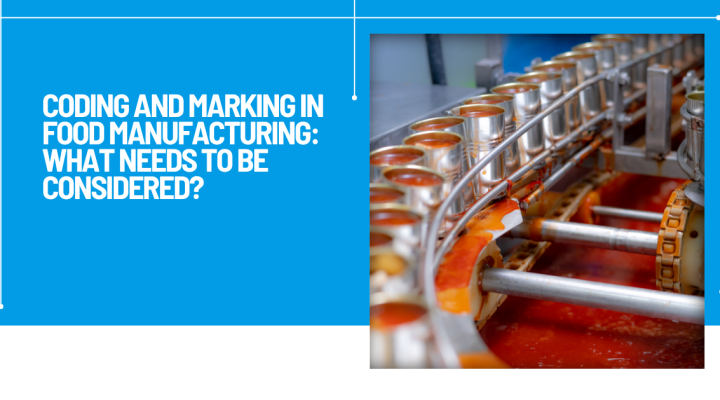
Product coding is a fundamental part of food manufacturing, but it is often only noticed when something goes wrong.
A faint best-before date, a missing batch code or an unreadable barcode can quickly become a much bigger issue. Products may need to be removed from the line, packaging may be wasted and valuable production time can be lost while the problem is investigated.
For this reason, choosing the right coding and marking solution is about far more than simply printing a date onto a product.
Food manufacturers need to consider the product, the packaging, the production environment, line speeds and the information that needs to be printed. The right solution for one application may not necessarily be suitable for another.
At Industrial Printer Services, we regularly work with manufacturers to look at the complete application before recommending a coding or marking solution. Getting the basics right at the beginning can prevent many of the problems that businesses encounter later.
So, what should food manufacturers consider when reviewing their product coding and marking requirements?
The first question may sound obvious, but it is an important one.
What exactly needs to appear on the product or packaging?
Depending on the application, this could include:
The amount of information being printed can influence the technology and setup required.
A simple date code may have very different requirements from a larger code containing multiple lines of information or a barcode that needs to be scanned reliably.
It is also worth thinking about whether your coding requirements are likely to change.
As product ranges develop and traceability requirements become more detailed, businesses may need greater flexibility from their coding equipment. Planning for future requirements can help prevent a solution from becoming restrictive sooner than expected.
The packaging material is one of the most important considerations.
Food products can be packed in a wide variety of materials, including:
Each surface behaves differently.
An ink that performs well on glass may not be the right choice for flexible packaging. A coding solution used for outer cases may be completely different from the one required for individual retail packs.
The surface itself is only part of the consideration. It is also important to understand whether the material is smooth, textured, coated, curved or likely to move during production.
The right printer and consumable combination should be selected for the specific application rather than simply because it has worked successfully elsewhere.
Printing the code is only the first part of the job.
The code also needs to remain clear and legible for as long as required.
Food packaging can be exposed to a variety of conditions between production and the point of sale. Products may be refrigerated, frozen, handled repeatedly or exposed to moisture and condensation.
This means the code needs to be suitable for the environment the product will encounter.
For example, a code that looks perfectly acceptable when it leaves the production line may not remain as clear if the ink does not adhere correctly to the packaging or if the product is exposed to challenging conditions later in the supply chain.
This is why choosing the right ink is just as important as choosing the right printer.
The application should always be assessed as a whole.
A coding solution may work perfectly during a demonstration but behave differently on a busy production line.
Line speed, product movement, available space and the position where the code needs to be applied can all affect the final result.
It is important to consider:
The coding equipment should work with the production process rather than create additional challenges for operators.
If a printer requires constant adjustment or products need to be positioned precisely to achieve a reliable code, the application may need to be reviewed.
A code that is technically present is not necessarily a good code.
It needs to be clear, correctly positioned and easy to read.
For barcodes and other machine-readable codes, reliable scanning is also essential.
Poor print quality can lead to problems further along the supply chain, while incorrect or unreadable codes can create issues with traceability and product identification.
It is important to consider the size, location and quality of the code before the system is installed.
Where possible, testing the application with the actual packaging and production conditions can help identify potential issues early.
For most food manufacturers, the answer is simple: very.
A coding issue can stop an otherwise productive line.
That is why reliability should be considered alongside the initial cost of the equipment.
The cheapest option is not always the most cost-effective over time. Ink consumption, maintenance requirements, spare parts, servicing and potential downtime should all be considered.
A reliable coding solution should also be practical for the people using it.
If operators are regularly having to intervene, clean the printer, make adjustments or troubleshoot problems, there may be a better way of approaching the application.
The long-term cost of coding equipment is about more than the purchase price.
Food manufacturing environments can be demanding.
Temperature changes, moisture, dust and regular cleaning processes can all have an impact on industrial equipment.
The location of the printer and the conditions around it should therefore be considered as part of the specification.
A coding system needs to be appropriate for the environment in which it will operate.
For example, equipment positioned close to washdown areas may face very different conditions from a printer installed on a dry packaging line.
Understanding the environment helps ensure that the equipment is suitable and can continue to perform reliably.
Flexibility can be particularly important for manufacturers producing a wide range of products.
Different products may require different codes, while packaging formats may change throughout the day.
The more changeovers a production line has, the more important it becomes to ensure that coding information can be changed accurately and efficiently.
Frequent manual adjustments can increase the risk of errors.
This is where the overall setup and operator process become important. Coding equipment should make it easier to manage different products and production runs, not create unnecessary complexity.
When reviewing a coding solution, think about the products you produce today, but also where the business may be heading over the next few years.
Product identification and traceability requirements continue to develop.
The use of 2D barcodes and more detailed product information is expected to become increasingly important across the wider retail and food supply chain.
Businesses do not necessarily need to change all of their equipment immediately, but they should understand whether their existing coding systems can accommodate future requirements.
Waiting until a new requirement becomes urgent can limit the time available to properly assess the best solution.
A planned approach allows manufacturers to review their options, consider existing equipment and make changes when they make commercial and operational sense.
The printer is only one part of the solution
When businesses experience coding problems, the printer is often the first thing to be blamed.
But coding performance can be influenced by a number of factors.
The printer itself is important, but so are:
Looking at the complete application is often the best way to identify the cause of a problem and avoid simply treating the symptoms.
Sometimes the answer may be a new printer. In other situations, a different ink, an adjustment to the setup or improved maintenance may resolve the issue.
There is no single coding solution that is right for every food manufacturer.
The best approach is to start with the application.
What needs to be printed? What material are you coding onto? How fast is the production line running? What conditions will the product experience? How might your requirements change in the future?
Answering these questions before selecting equipment can help avoid costly problems further down the line.
At Industrial Printer Services, we work with food manufacturers to understand their individual coding and marking requirements before recommending a suitable solution.
From product coding and date marking through to case coding and pallet labelling, the aim is always the same: to help manufacturers achieve clear, reliable and consistent codes that work within their production environment.
Contact us today if you are reviewing your current coding equipment or planning changes to a food production line, speak to the IPS team about your application and coding requirements.

A complete solution for all industrial coding and marking equipment.
Industrial Printer Services Copyright 2026 | Created by GEL Studios